



Solar Information
Solar images from SOHO
The Sun Now
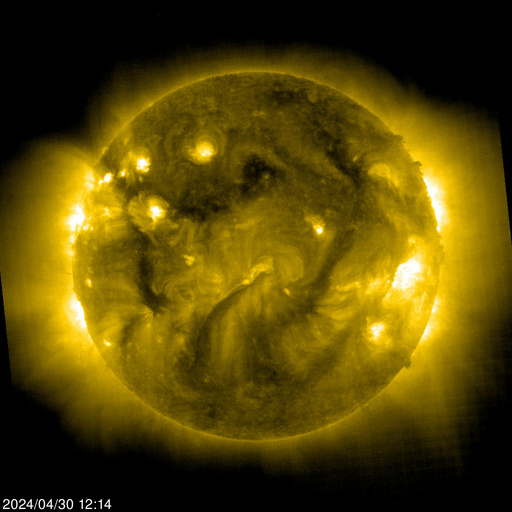
Extreme ultraviolet Imaging Telescope image at 284 Angstrom (to 2 million degrees K)
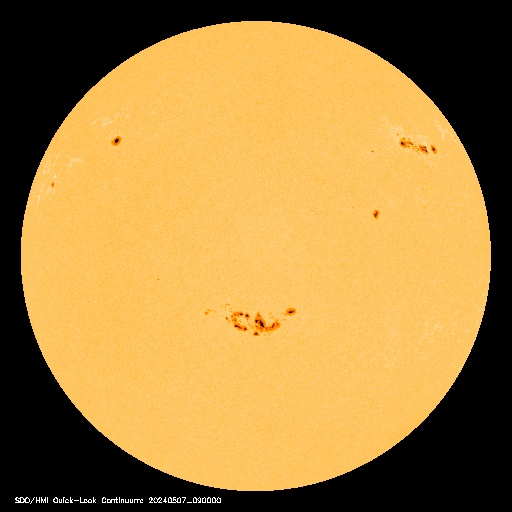
Michelson Doppler Imager (MDI) image showing sunspots
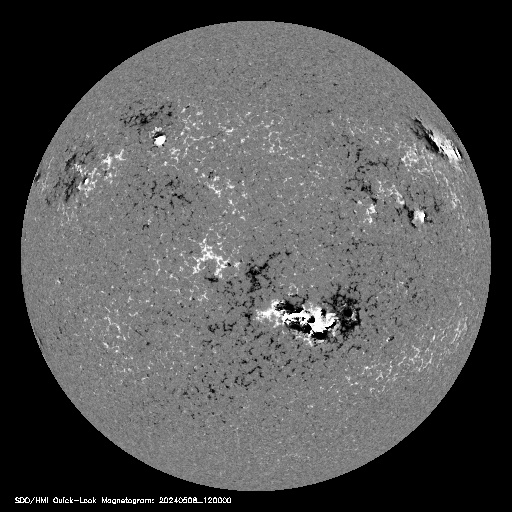
Magnetogram image showing magnetic field, black and white show opposite polarities
Information from the Space Weather Prediction Center, Boulder, CO
National Oceanic and Atmospheric Administration (NOAA)
Aurora Activity

Solar Cycle
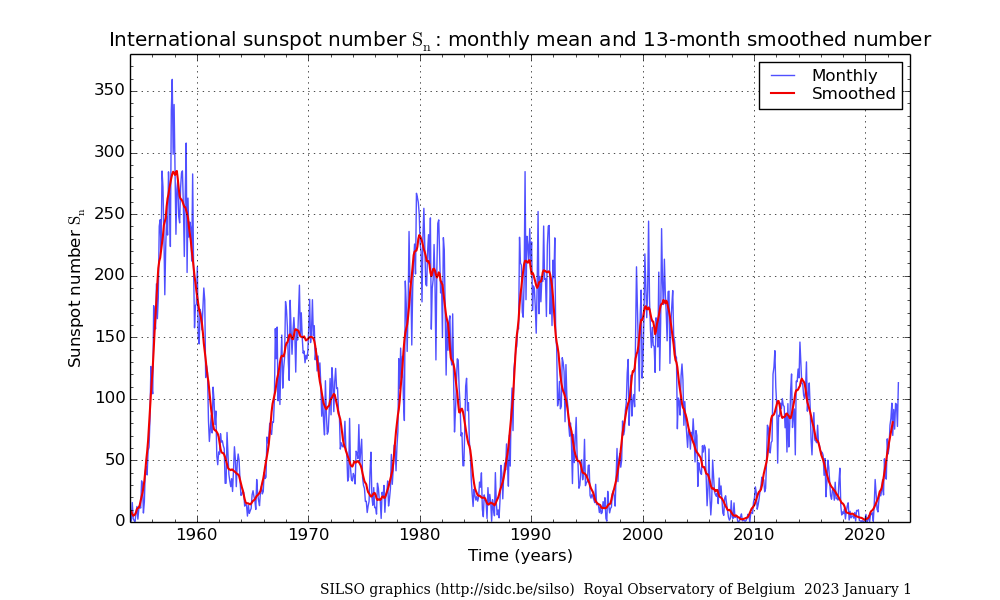
Sun Spot Number Progression
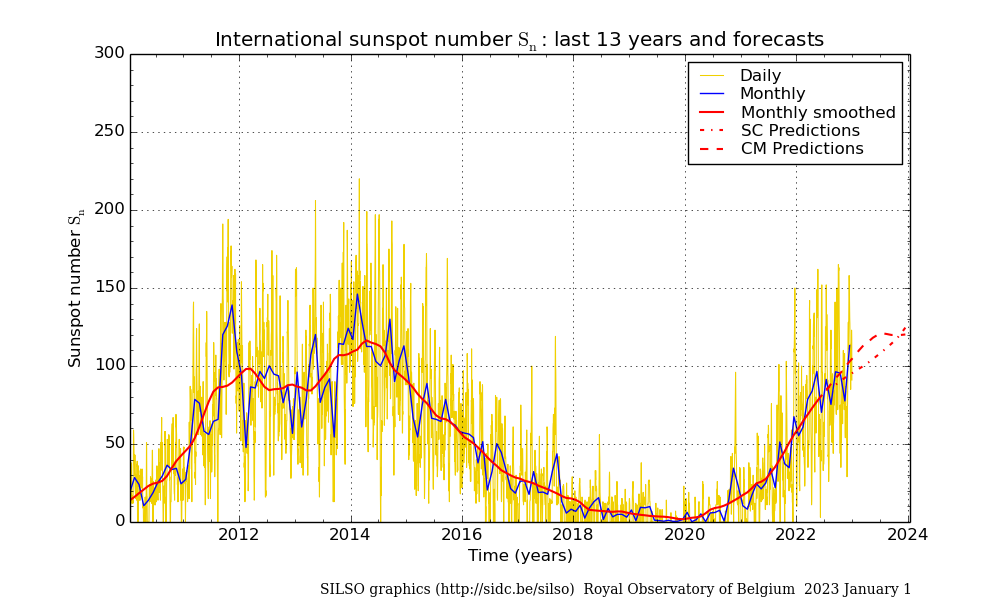
Last 5 cycles Sun Spot Number Progression
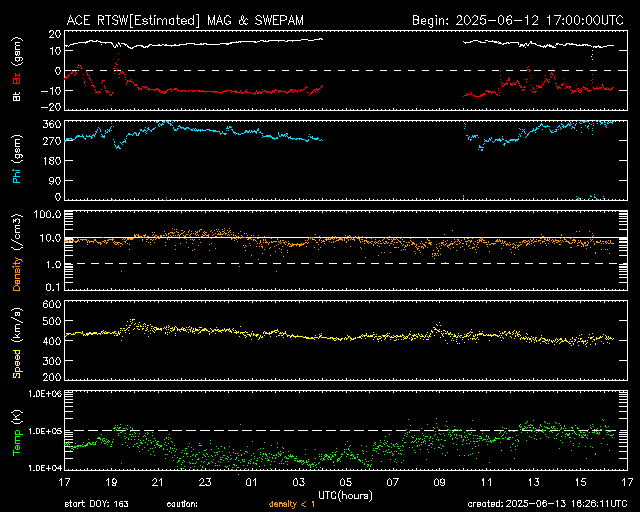
Solar Wind
3-day Solar-Geophysical Forecast
:Product: 3-Day Forecast
:Issued: 2026 Jul 16 1230 UTC
# Prepared by the U.S. Dept. of Commerce, NOAA, Space Weather Prediction Center
#
A. NOAA Geomagnetic Activity Observation and Forecast

The greatest observed 3 hr Kp over the past 24 hours was 3 (below NOAA
Scale levels).
The greatest expected 3 hr Kp for Jul 16-Jul 18 2026 is 3.00 (below NOAA
Scale levels).

NOAA Kp index breakdown Jul 16-Jul 18 2026

             Jul 16       Jul 17       Jul 18
00-03UT       2.33         2.67         1.67
03-06UT       3.00         2.33         1.33
06-09UT       2.00         2.00         1.33
09-12UT       1.67         1.33         1.33
12-15UT       1.33         1.33         1.33
15-18UT       2.00         1.67         1.33
18-21UT       2.00         2.00         1.67
21-00UT       2.00         2.33         1.67

Rationale: No G1 (Minor) or greater geomagnetic storms are expected.  No
significant transient or recurrent solar wind features are forecast.

B. NOAA Solar Radiation Activity Observation and Forecast

Solar radiation, as observed by NOAA GOES-18 over the past 24 hours, was
below S-scale storm level thresholds.

Solar Radiation Storm Forecast for Jul 16-Jul 18 2026

              Jul 16  Jul 17  Jul 18
S1 or greater    1%      1%      1%

Rationale: No S1 (Minor) or greater solar radiation storms are expected.
No significant active region activity favorable for radiation storm
production is forecast.

C. NOAA Radio Blackout Activity and Forecast

No radio blackouts were observed over the past 24 hours.

Radio Blackout Forecast for Jul 16-Jul 18 2026

              Jul 16        Jul 17        Jul 18
R1-R2           10%           10%           10%
R3 or greater    1%            1%            1%

Rationale: A slight chance for R1-R2 (Minor-Moderate) radio blackouts
will persist through 18 Jul primarily due to returning regions on the
east limb.
